Read our article on the advantages of growing strawberries in growing media to learn more about the differences between this method and growing in open soil. Now, let’s get into the technical conditions for strawberry cultivation.
Conditions for successful strawberry cultivation
Are you considering switching to strawberry cultivation in growing media? This article outlines the key technical conditions for successful cultivation.
Successful strawberry cultivation in growing media depends on four key factors: irrigation water quality, correct EC and pH management, a structurally stable growing medium, and a balanced selection of raw materials.
Water quality
Access to good-quality water is essential when growing strawberries in growing media. It’s one of the main conditions for strawberry cultivation. Make sure to have your fresh irrigation water analysed before deciding to make the switch. In the following paragraphs we’ll cover the main parameters used to assess water quality and explain why they matter.
Conductivity (EC) and Salts
First, we will look at electrical conductivity, commonly referred to as EC. The required EC level of the irrigation water used for strawberry plants varies between 1.2 and 2.0 mS/cm, measured from the drip, depending on factors such as temperature and the growing stage. This parameter indicates the total concentration of dissolved salts in the irrigation water. Salts in water can either be useful nutrients like calcium, magnesium or sulphate, or ballast like chloride or sodium. These ballast salts can become toxic to plants when present in high concentrations. Make sure to take these salts and total EC level into account when composing a fertiliser mixture.
Acidity (pH) and bicarbonate
Another important parameter is pH. The right pH value is essential for good availability of nutrients. For strawberries the optimal water pH is usually between 5.5 and 6.0.
However, pH is not the sole indicator for calculating the amount of acid needed to bring the water to the right pH level. To determine that, you need to know the concentration of bicarbonate in the water. Bicarbonate needs to be neutralised by adding acid to the water. As long as bicarbonate is present in the water, the pH level will not change significantly when dosing acid. If exceptionally high bicarbonate concentrations are present, it might be necessary to pre-treat the water.
Iron
Finally let’s have a look at iron. This element is commonly found in groundwater. The presence of iron is not harmful to the plants, but it can cause drippers to become blocked. It can also leave brown stains on surfaces it comes into contact with. This only happens if the water contains over 10 micromol per litre. Upon exposure to air the iron particles change to iron oxide which causes the issues described above. Water containing high iron levels can be treated to remove iron before use.
Growing media quality
Of course the type of growing medium you use for your crops is highly important for successful cultivation. It needs to meet several requirements. It’s essential the growing medium takes up and holds water and nutrients. In addition it should also keep both easily available to the plant roots when needed.
In addition the air capacity in the growing medium is important as well, as the roots need enough oxygen and space to grow. A suitable growing medium contains enough pores of different sizes to allow air to be exchanged throughout the entire container volume.
For long-term cropping it’s important the growing medium has optimal long-lasting characteristics, making sure it doesn’t compact and providing the plant with durable structural stability.
Parameters for growing media
So, if we can use parameters to judge water quality, we can also set parameters to determine substrate suitability. Some of the most important parameters are:
- air-filled porosity,
- water uptake characteristic (WOK),
- water and nutrient absorption and release patterns,
- chemical and structural stability.
Now, let’s look at some commonly used raw materials in the second part of this article.
Growing media composition
The most common raw materials used in the berry industry are peat, coir and perlite. We’ll have a look at the characteristics of these materials and why the right growing media composition is one of the conditions for strawberry cultivation.
Peat
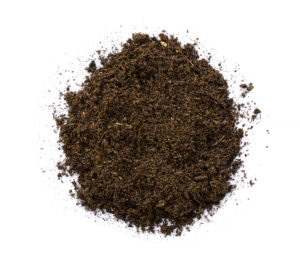
Peat actually is formed from partially decomposed plant material in a low-oxygen environment.
You mainly find peat in the Northern Hemisphere, originating from multiple different countries. The climate and local environmental changes influence the way peat turns out. This causes the characteristics of peat to vary depending on the harvesting area. Characteristics also vary in peat from lower and higher layers. The peat that’s harvested at the greatest depth is the oldest material, and therefore the material that is most decomposed. This is the dark, or black peat. In the higher layers the level of decomposition decreases and the peat changes to brown and white. The more decomposed black peat contains less air than younger white peat.
So, the characteristics of the peat vary depending on origin and harvesting depth. In addition the harvesting and screening methods can greatly influence the physical characteristics of peat as well. For example, vertically harvested block peat adds better structural stability to a mixture than horizontally harvested milled peat.
Peat and pH
The acidity of a mixture controls the availability of nutrients for the plants. Peat adds a pH buffer to a mixture, making sure the mixture is protected against sudden changes in pH levels. This is caused by the humic acids present in the raw material. They are weak acids that add hydrogen ions to the solution when pH rises. When pH falls they pick up protons. As a result the pH doesn’t change.
Coconut coir
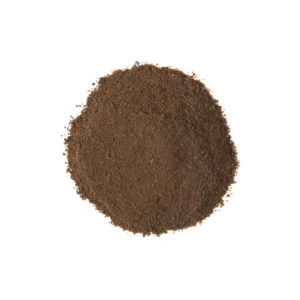
Coir is another common raw material in the berry industry. It comes from the inside of coconut husks. This is filled with fibre and a “coconut pulp”. This coir dust can be used in growing media. It provides a relatively good and stable structure to the mixture and is fairly easy to handle.
pH buffering
Coir has a minimal pH buffering capacity, which makes crops growing in pure coir susceptible to pH-related nutrient deficiencies.
Cation exchange complex
In addition, coir has a negatively charged complex which is naturally saturated with sodium and potassium. We call this the cation exchange complex (CEC).
However, calcium and magnesium are strongly attracted to this complex. This can cause a “lock-up” in the complex when adding fertiliser. This means the coir will release sodium and potassium to the plant and takes up the calcium and magnesium. This causes a variety of crop problems like excessive salt uptake and calcium deficiencies.
Avoiding these issues is one of the highly relevant conditions for successful strawberry cultivation. To avoid these problems, coir should always be pre-buffered with calcium and flushed.
Perlite
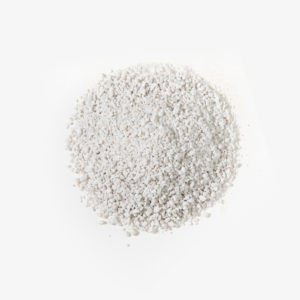
Perlite is volcanic glass (silicon dioxide). Companies heat particles of this glass to make them “pop” (like popcorn). This causes the perlite to grow to 15-20 times its original volume. The material has a very stable structure and adds aeration to growing media mixtures. Perlite also increases the speed at which a mixture retains moisture.
Combining these raw materials enables us to create a balanced, high-quality growing medium. We can easily tailor these mixtures to the needs of a grower and the unique circumstances at the growing facilities. Have a look at our Strawberry product portfolio to learn about our different product lines. Or ask our team for personalised advice.